SCIENTIFIC EVIDENCE*
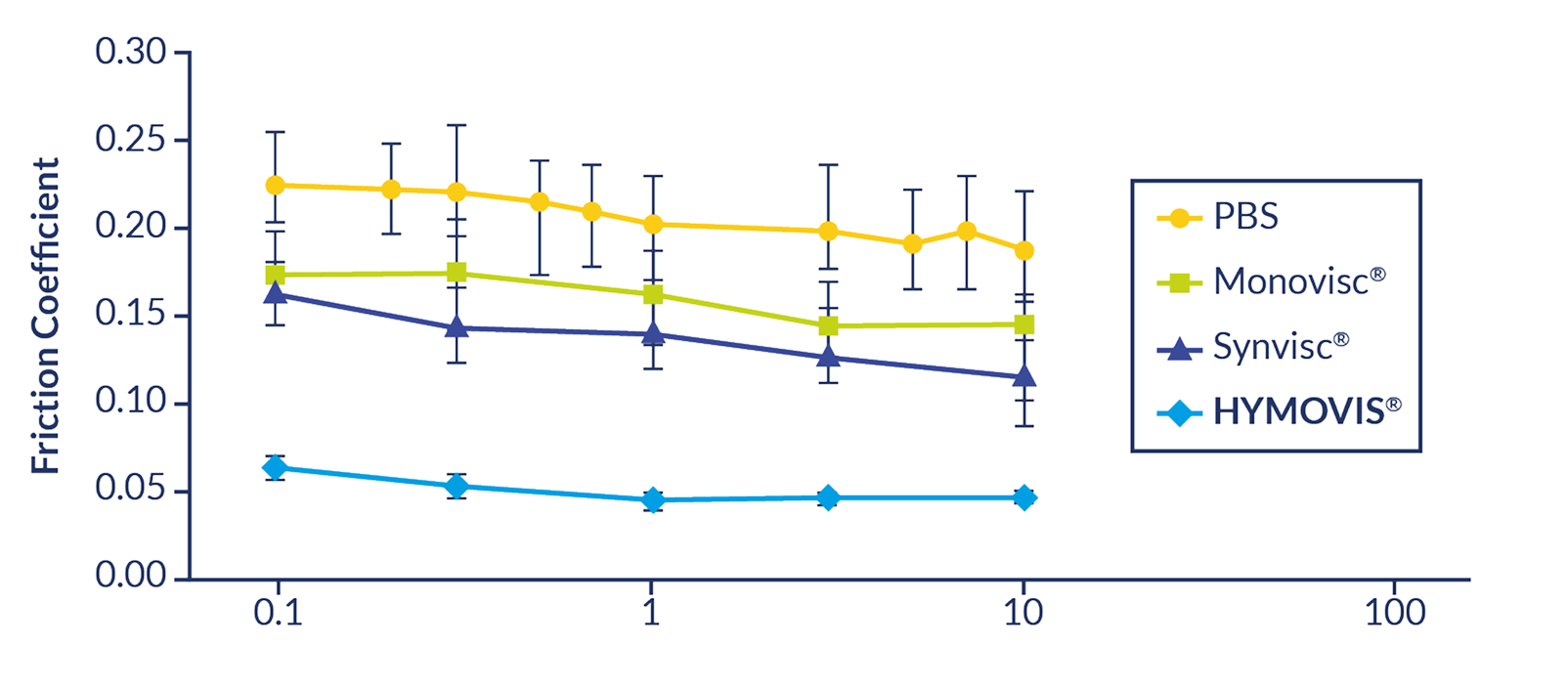
Greater Lubrication and Superior Friction Reduction3*
HYMOVIS® ONE is a true viscoelastic hydrogel – its unique molecular structure significantly
improved lubrication, reducing friction on cartilage in a preclinical analysis3*
HA effects of friction reduction on cartilage at various sliding speeds*
Sliding Speed (mm/s)
*Preclinical test data may not be indicative of human clinical outcomes.
Several hyaluronan (HA) viscosupplement products were assessed in this preclinical analysis. This graph demonstrates
preclinical comparison of selected single-injection HA viscosupplements.
The molecule of HYMOVIS® is the same as HYMOVIS® ONE. The molecule of Synvisc® is the same as Synvisc® One.
Third-party trademarks used herein are trademarks of their respective owners
PBS = Phosphate buffered saline
In a pre-clinical study
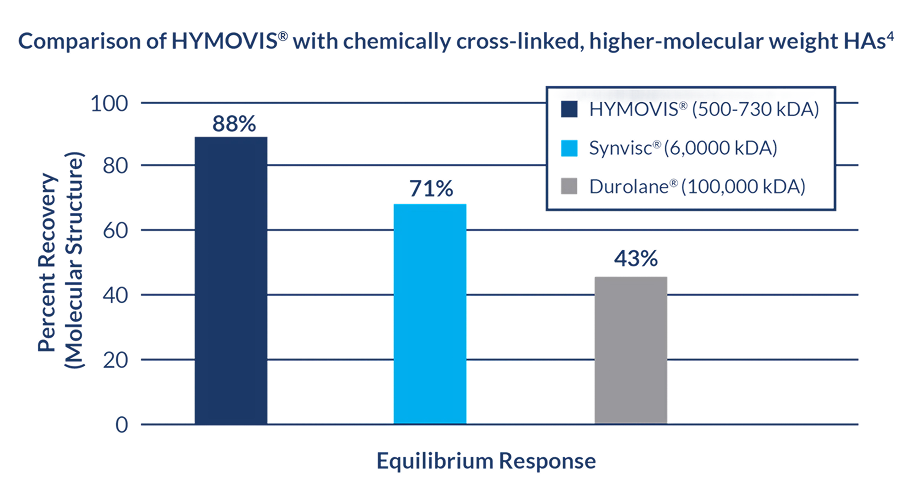
HYMOVIS® ONE demonstrated greater recovery of molecular structure (elasticity) under repeated mechanical stress4*
*Preclinical test data may not be indicative of human clinical outcomes.
The molecule of HYMOVIS® is the same as HYMOVIS® ONE. The molecule of Synvisc® is the same as Synvisc® One.
Third-party trademarks used herein are trademarks of their respective owners.
All 3 HAs started at a pre-stress baseline of 100% and had an instantaneous post-stress response of 29%.*
Following repeated stress, the structure of HYMOVIS® stabilizes due to the reversible hydrophobic interactions of the amide-containing alkyl side chains.*
Study design: Recovery of mechanical properties after a shock was investigated as a function of time by oscillatory measurement after destruction of the gel network for each product: HYMOVIS®, Synvisc®, and Durolane®. The stress cycle was repeated 6 times
Indication
Important Safety Information
Rx Only. See package insert for full prescribing information including indications, contraindications, adverse events, warnings, precautions, and side effects.
References:
3. Bonnevie ED, Galesso D, Secchieri C, Bonassar LJ (2019) Frictional characterization of
injectable hyaluronic acids is more predictive of clinic outcomes than traditional rheological or
viscoelastic characterization. PLoS ONE 14(5): e0216702.
https://doi.org/10.1371/journal.pone.0216702
4. Finelli I, Chiessi E, Galesso D, Renier D, Paradossi G. A new viscosupplement based on
partially hydrophobic hyaluronic acid: a comparative study. Biorheology. 2011;48(5):263-275